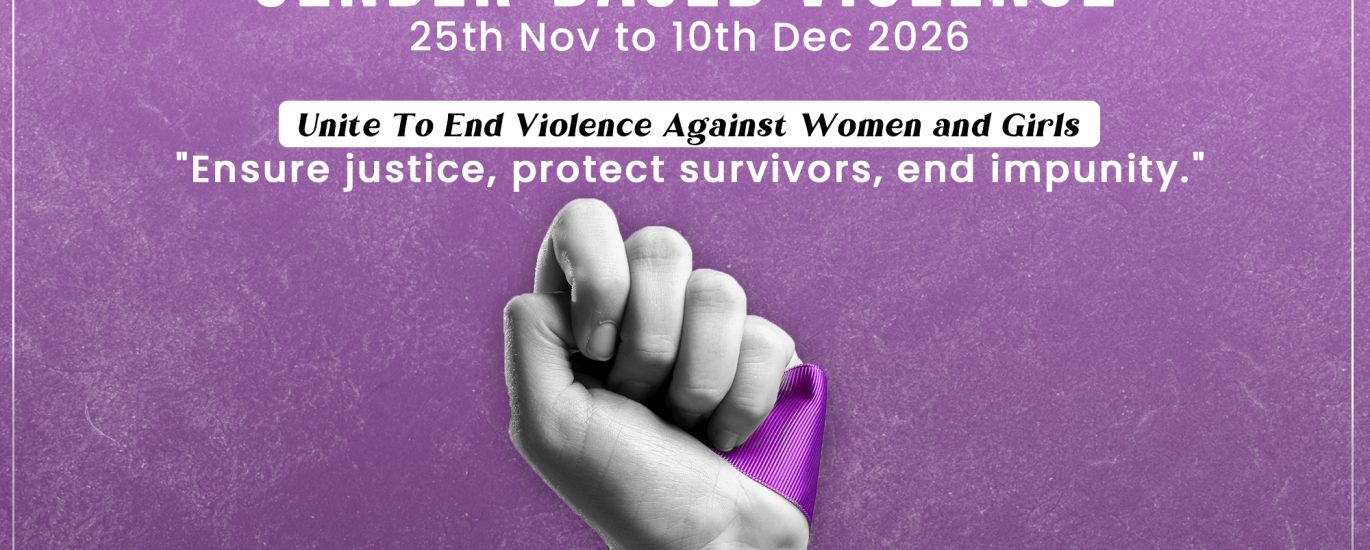
16 Days of Activism Against Gender-Based Violence 2026 | 25 November – 10 December
Theme: Ensure Justice, Protect Survivors, End Impunity
Gender-based violence remains one of the most persistent human rights violations affecting individuals, families and communities across the world. It undermines human dignity, limits opportunities, reinforces inequality and leaves lasting physical, psychological, emotional and social consequences for survivors.
As the world commemorates the 2026 16 Days of Activism Against Gender-Based Violence, Girls Activist Youth Organisation (GAYO) joins the global movement in calling for stronger justice systems, meaningful survivor protection and accountability for perpetrators.
This year’s theme, “Ensure Justice, Protect Survivors, End Impunity,” is a reminder that ending gender-based violence requires more than statements of solidarity. It demands action, accessible justice, effective protection mechanisms and a willingness to confront the social norms and institutional failures that allow violence to continue.
However, as we intensify our efforts to end GBV, we must also broaden our understanding of who experiences violence, whose voices are heard and who receives protection.
Gender-based violence: A human rights issue affecting everyone
Gender-based violence refers to harmful acts directed at individuals because of their gender, or acts that disproportionately affect people of a particular gender. It includes physical, sexual, psychological and economic violence, as well as harmful practices and forms of exploitation.
Women and girls continue to experience a disproportionate burden of gender-based violence globally. Sexual violence, domestic abuse, child marriage, female genital mutilation, human trafficking, online harassment and other forms of exploitation continue to threaten their safety, dignity and opportunities.
In many communities, unequal power relations, harmful cultural practices, economic dependence and discriminatory social norms contribute to the persistence of these violations.
For girls and young women, the consequences can be particularly devastating. Violence can interrupt education, restrict participation in public life, undermine economic independence and expose survivors to long-term physical and psychological harm.
These realities demand sustained attention, targeted interventions and strong policies that address the structural inequalities placing women and girls at risk.
But recognising the disproportionate impact on women and girls should not mean overlooking other survivors.
Men and boys are victims too Breaking the silence
One important dimension that is often missing from conversations about gender-based violence is the experience of men and boys as victims and survivors.
Although they are less frequently recognised in public discussions, men and boys can experience sexual violence, domestic abuse, physical assault, emotional and psychological abuse, exploitation, trafficking and other forms of gender-related violence.
Yet, their experiences are often surrounded by silence.
Social expectations about masculinity frequently portray men as strong, emotionally invulnerable and capable of protecting themselves. These expectations can create an environment in which male survivors feel ashamed, fear being ridiculed or believe that reporting abuse will undermine their identity or social standing.
A boy who experiences sexual abuse may fear that he will not be believed. A man experiencing domestic violence may hesitate to seek assistance because society expects him to be physically stronger or always in control. Male survivors may also struggle to access services that are not adequately designed to recognise their experiences and needs.
These barriers can prevent survivors from reporting violence, seeking medical attention, accessing psychosocial support or pursuing justice.
The reality is simple: experiencing violence does not make someone less of a man, and being a survivor should never be a source of shame.
We must challenge the harmful stereotypes that silence male survivors and recognise that everyone deserves dignity, safety and protection.
An inclusive approach does not diminish the experiences of women and girls
Recognising men and boys as survivors should not be interpreted as an attempt to shift attention away from women and girls or minimise the inequalities they continue to face.
Women and girls remain disproportionately affected by many forms of gender-based violence, and addressing the underlying power imbalances, discrimination and harmful practices that place them at risk must remain a priority.
However, an effective response to GBV should be guided by the principle that every survivor deserves to be heard, believed, protected and supported.
An inclusive approach means understanding that different survivors experience violence in different circumstances and may face different barriers when seeking help.
It also means ensuring that justice and protection systems are responsive to the needs of women, girls, men and boys, including survivors with disabilities and those facing additional forms of discrimination.
We cannot claim to be building safe communities while allowing certain survivors to remain invisible simply because their experiences do not fit prevailing social expectations.
Justice must be accessible to every survivor
The 2026 theme calls for justice, survivor protection and an end to impunity. These priorities must translate into practical action.
For many survivors, reporting violence is only the beginning of a difficult journey. Fear of retaliation, victim-blaming, social stigma, financial limitations, inadequate support services and lengthy judicial processes can discourage survivors from pursuing justice.
In some cases, survivors are pressured to remain silent to protect family reputations, preserve relationships or avoid social exclusion.
Such circumstances allow perpetrators to escape accountability and reinforce the belief that violence can be committed without consequences.
The role of communities and young people in ending GBV
Ending gender-based violence cannot be left to governments and law enforcement institutions alone. Communities have an important role in challenging the attitudes and behaviours that normalise violence.
Families must create environments where children can speak about abuse without fear. Schools must establish safe reporting mechanisms and protect learners from harassment, exploitation and violence. Community leaders must challenge harmful practices and promote accountability.
Young people, in particular, have an important role in transforming the social norms that perpetuate gender-based violence.
Through peer education, community engagement, digital advocacy and youth-led initiatives, young people can challenge harmful stereotypes, promote respectful relationships and encourage survivors to seek support.
We must also create safe spaces where boys and men can discuss harmful expectations around masculinity, learn to recognise violence and become active participants in building non-violent communities.
Importantly, engaging men and boys in preventing GBV must go hand in hand with listening to survivors, challenging unequal power relations and ensuring accountability.
GAYO’s call to action: No survivor should be left behind
As Girls Activist Youth Organisation (GAYO), we believe that every individual deserves to live free from violence, exploitation, discrimination and fear.
Our commitment to gender equality and the protection of children, girls, young women and other vulnerable groups requires us to confront all forms of violence and the social structures that enable them.
During these 16 Days of Activism, we call upon policymakers, justice institutions, civil society organisations, development partners, communities and young people to move beyond awareness and take meaningful action.
We must ensure that women and girls who experience violence receive the attention, protection and justice they deserve. Equally, we must recognise and support men and boys who experience violence, challenge the stigma that silences them and ensure that their experiences are not dismissed.
No survivor should have to prove their suffering to deserve protection. No perpetrator should be shielded by social status, gender or influence. And no individual should be denied justice because society does not recognise them as a potential victim.
Ending gender-based violence requires a society that listens to every survivor, protects every individual and holds every perpetrator accountable.
As we commemorate the 2026 16 Days of Activism, let us make our collective commitment clear:
Ensure justice. Protect survivors. End impunity.
Because justice must have no gender, and no survivor should be left behind.
Girls Activist Youth Organisation (GAYO) stands for a world where everyone can live with dignity, equality and freedom from gender-based violence.